
Solution Themes

Buildings and Housing (Stationary Energy)

Energy Systems (Stationary Energy)

Mobility and Transports

Waste and Circular Economy

Green Industry (IPPU)
Nature Based solutions, green infrastructures and agriculture (AFOLU)
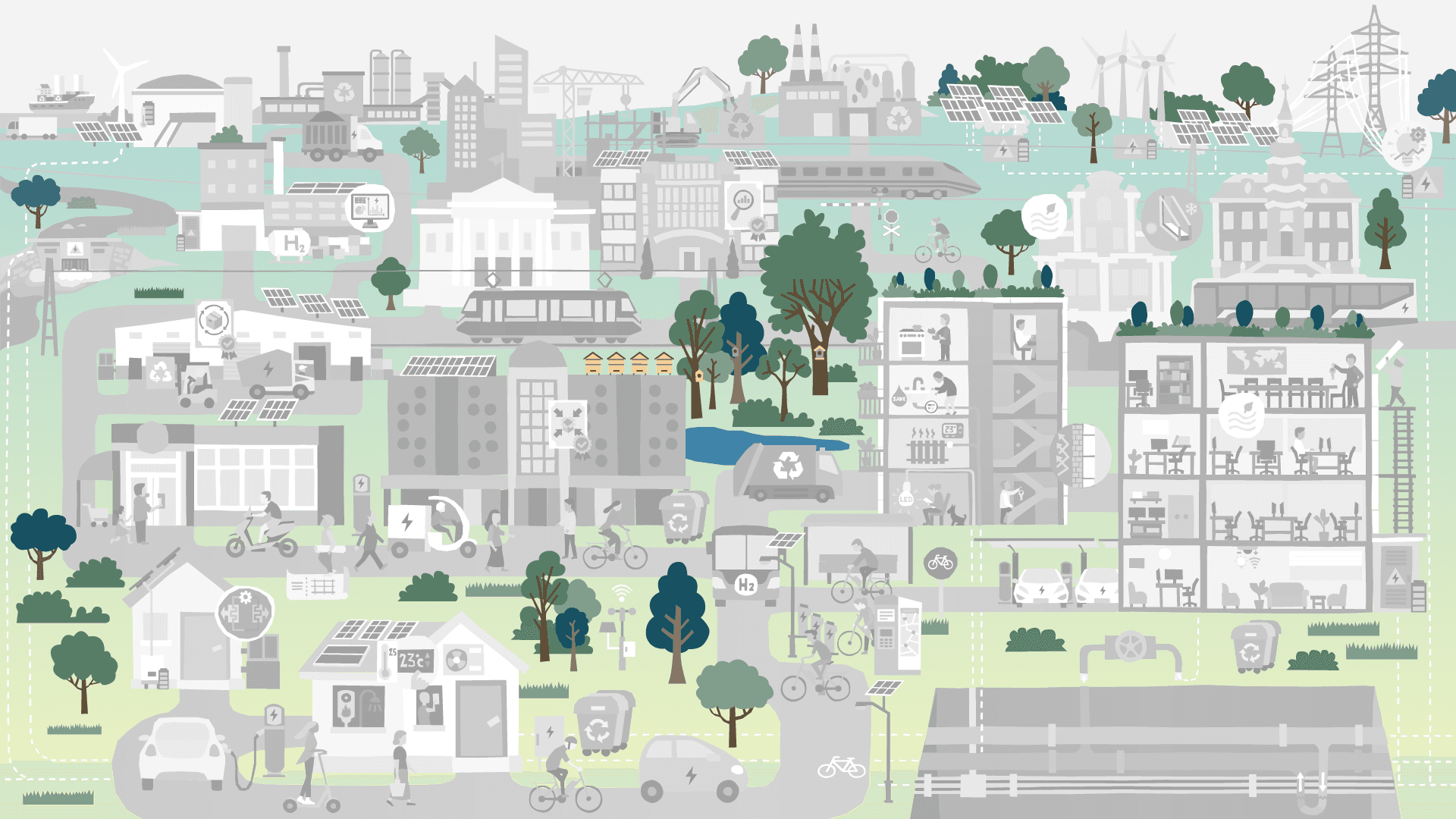
This page provides an overview of resources on the topic of Agriculture, Forestry and Other Land Use (AFOLU), Nature Based Solutions (NBS) and green infrastructure, with typologies of solutions and cases from Mission Cities

Nature Based solutions, green infrastructures and agriculture (AFOLU)
To address emissions from land use changes, cities should implement nature-based solutions (NBS) like urban green spaces to create carbon sinks and manage residual emissions. Effective climate action combines carbon storage with sustainable urban planning and infrastructure, such as green pavements and floodable parks. These measures cut emissions, improve resilience to climate impacts and offer health and biodiversity co-benefits.
Reading Resources
Concept: Urban heat island effect mitigation – Evaporative Cooling
The heat island phenomenon rises the temperature of cities, increases the energy demand for cooling and deteriorates comfort conditions in the urban environment. To counterbalance the impact of the phenomenon, important mitigation techniques have been proposed and developed.
Concept: Urban heat island effect mitigation - Cool urban surfaces (reflective)
The heat island phenomenon raises the temperature of cities, increases the energy demand for cooling and deteriorates comfort conditions in the urban environment. To counterbalance the impact of the phenomenon, important mitigation techniques have been proposed and developed.
NBS and Green Infrastructure Mapping
Green Infrastructure (GI) refers to a strategically planned network of natural and semi-natural spaces. In urban environments specifically, GI serves as a nature-based solution which is multi-functional and economically and socially sustainable, compared to grey infrastructure. GI provides clean air and water and carbon storage, enhances biodiversity and wildlife, and helps cities with climate change adaptation attempts.
NBS and Green Infrastructure plans and strategy design and governance
Thanks to their multifunctionality, NBS can address several urban challenges, in particular related to climate change, urban resilience and human health and well-being. For this reason, NBS require proactive policy intervention to be mainstreamed and integrated into urban policies, planning processes, and decision-making mechanisms.
Guidance for cities to help prepare an Urban Greening Plan
Urban Greening Plans articulate, formalise and showcase a city’s commitment to promoting biodiversity and urban greening. This guidance document sets out the background, rationale and key elements needed to produce and successfully implement an Urban Greening Plan. It is accompanied by a toolkit that goes into more detail on each step and gives links to relevant tools, initiatives and good practice examples.
Allotments, community gardens and floating gardens
By 2050, the majority of people (67 %) will live in urban areas [1], one of the reasons why urban agriculture and gardening is becoming a topic of growing interest. In addition to providing fresh food to urban areas, community and rooftop gardens provide environmental, social and health benefits, as well as opportunities for economic development. Urban agriculture does not only address climate issues by supporting CO2 storage in urban areas, but it also addresses environmental issues created by food transport and logistics by allowing food to be grown closer to home, thus supporting food security in the long run.
Smart‑soils and phytoremediation
Healthy soil can serve as a vital carbon store. Climate-smart soil management is therefore crucial and can help to make agricultural practices more resilient to the consequences of climate change. Innovative technologies can improve fertility and soil biodiversity as well as reduce risks for erosion.
Rain Gardens & Bioretention
In urban areas, rainwater falls and runs off mineralized surfaces (asphalt, concrete, bitumen, etc.). For cities, this generates problems in terms of: water pollution: instead of being absorbed by the soil, rainwater is loaded with pollutants from the leaching of the impermeable surfaces on which it runs; flooding, due to an excessive volume of runoff water that can clog up the existing sewage system. This is why there are integrated rainwater management techniques at the plot level, which improve water quality and reduce the volumes and flows discharged into the networks.
Vertical green infrastructure: Green fences, green noise barriers, vertical mobile gardens
Vertical green infrastructure (VGI) has a great potential to support climate transition of compact urban areas. VGI does not compete for land use, but is able to support microclimate regulation through cooling capacities, to reduce noise pollution, to recycle and upcycle rainwater and grey water, to produce food or habitat for species, and to generate pleasant green spaces, with a significant aesthetic value.
Green roofs
Green infrastructure means introducing vegetation on/in man-made buildings and constructions to provide environmental, economic, and social benefits (i.e., clean air and water, climate regulation, food provision, erosion control, and places for recreation). Green roofs advantages over traditional solutions include reduction of surface runoff in large cities, reduced urban heat islands, support to biodiversity, improvement of the durability of waterproofing materials, increase of energy savings in buildings, and enhanced carbon sinking capacity.
Concept: Urban heat island effect mitigation - Greenery
Nature-based Solutions and Carbon sinks, green infrastructure and agriculture (ALOFU)
As shown in the Net‐Zero Emissions by 2050 Scenario [1] of the IEA, to reach climate neutrality by 2050 part of the emissions will need to be offset with carbon dioxide removal (CDR). In fact, in the Info Kit for Cities is mentioned that “If cities have GHG emissions which cannot be fully mitigated by 2030 due to technological or financial constraints, those so-called residual emissions will have to be compensated”. To deal with residual emissions, carbon sinks are the best option.
Tree planting (urban forestry/urban trees), parks and (semi) natural urban green areas
Tree planting (urban forestry/urban trees), parks and (semi) natural urban green areas Greening cities is a transversal solution to numerous urban challenges, not only to support the transition towards climate neutrality, but also to improve biodiversity, social justice and resilience. Greening cities can include many diverse solutions, among them tree planting and the development of parks and natural urban green areas.
Mobility management
Defines mobility management as a behavioural-change strategy using soft measures like awareness campaigns, travel planning, and stakeholder engagement to reduce car use and support sustainable mobility.
Concept: 15-minute city
Introduces the 15-minute city concept, promoting proximity-based urban planning to reduce car dependency and improve accessibility and livability.
Integrated land use planning and urban space management with mobility planning
Explains integrated land-use and mobility planning to reduce car dependency, support modal shift, and enable 15-minute city concepts through multimodal, people-centered urban design. Useful for planners aligning transport, accessibility, and spatial development strategies.
Concept: Smart Grid
Smart grid is the concept that describes the evolution of power systems to integrate and utilise techniques to adjust the flow of power to optimise the match between electricity supply and demand. The term 'smart grids' is used to define the integration of new technologies and methods, often data-driven, in existing power system infrastructure.
Concept: Eco-districts / Green neighbourhoods
As it happens with some other subsets of sustainability term or its application (i.e.: climate-neutral city, smart-sustainable city), there is not unique and clear definition for the eco-district term. Generalist definitions describe an eco-district as an urban development aiming to deploy the objectives of sustainable development, focusing on integrating environmental, social and economic goals.
Vulnerability and risk information systems
Describes digital systems that support disaster risk assessment, climate adaptation planning and resilience management using integrated data sources.
Rain garden
In urban areas, rainwater falls and runs off mineralized surfaces (asphalt, concrete, bitumen, etc.). For cities, this generates problems in terms of water pollution and flooding. This is why there are integrated rainwater management techniques at the plot level, which improve water quality and reduce the volumes and flows discharged into the networks.
Constructed wetland
Urban runoff can contribute to flooding and abrupt contribution to flow in peri-urban/urban streams. It is also frequently characterized by poor water quality, as runoff might contain a mix of contaminated sediments, pollutants, oils through to feltilizers and pesticides if these are not properly applied. In order to meet such challenges, alternative solutions exist, such as the one specified below. Constructed Wetlands (CW) are fully engineered systems using natural processes to treat water for household (blackwater or greywater) and/or biodegradable municipal or industrial wastewater, as well as manage runoff. They use wetland vegetation, soils, and their associated microbial assemblages to assist in treating wastewate
Water irrigation and maintenance technologies
The needs of sustainable and climate resilience cities are driven along with social, ecological and technological transformations. In recent years, technological advances have increased remarkably, which has prompted the exploration of how urban systems can be transformed into "smart cities". The use of information and communications technologies, the Internet of Things, and robotic systems and artificial intelligence have enabled the creation of "smart" technologies to monitor and manage nature-based solutions.
Sustainable Urban Drainage Systems (SuDS)
Sustainable urban drainage systems (SUDS) are a wide category of water interventions to align modern drainage systems with natural water processes. SUDS comprise “a sequence of management practices, control structures, solutions and strategies designed to efficiently and sustainably drain surface water, while minimising pollution and managing the impact on water quality of local water bodies”.
Green pavements: hard drainage pavements; green parking pavements
Green Pavements and hard drainage pavements are particular types of pavements made out of a porous concrete surface, open pore pavers or asphalt, with an underlying stone reservoir or water channels touching the soil. Those solutions allow water to filter on the inside and be absorbed by the ground -or drained via a drain tile- instead of running over.
Floodable park
Flooding, along with related storms, is the most important natural hazard in Europe in terms of human and economic loss and the intensity of flood events has grown in the last years. In urban areas, the waterproofing of soils is incrementally increasing flood risk due to the presence of roads, industries and houses. The intensity and the frequency of flood events will increase in the next years due to global warming and the consequent change in the global water cycle. The resulting increased flood risk poses challenges to society, physical infrastructure and water quality.
Grassed swales and water retention pounds
Swales are shallow, flat bottomed, vegetated open channels designed to convey, treatand often attenuate surface water runoff. When incorporated into site design, they can enhance the natural landscape and provide aesthetic and biodiversity benefits. They are often used to drain roads, paths or car parks, where it is convenient to collect distributed in flows of runoff, or as a means of conveying runoff on the surface while enhancing access corridors or other open space. Swales can have a variety of profiles, can be uniform or non-uniform, and can incorporate a range of different planting strategies, depending upon the site characteristics and system objectives.
Hard drainage-flood prevention
This NBS focuses on the delivery additional ecological components within a hard/built engineering approach to water management. They aid the reduction in pluvial flood risk in urban areas and improve the quality of water within sewerage systems.
Community composting
The EU Waste framework directive (Directive 2018/851/EU) defines a target to recycle 65% of municipal waste by 2035, along with separate biowaste collection or recycling at source by 2023. Composting is a natural method of waste recycling whereby the organic waste, under natural or induced conditions, is converted into organic fertiliser or soil additives.
Green corridors for active and cooler mobility
The natural and built environment that surrounds us largely dictates our behaviours. When it comes to transportation, the domination of the streetscape by car-lanes naturally leads to higher car ownership and use. To address this challenge, the development of well-connected green corridors can promote a modal shift away from cars and towards sustainable mobility means, whether this is walking, cycling or micromobility.
Cooling trees
Cooling trees are appropriate at different scales: the isolated tree, rows of trees along a street, or at the scale of a city. In terms of mitigation, trees contribute to carbon sequestration through photosynthesis, which transforms carbon dioxide into organic matter.
Green resting areas, parks and urban forests, parklets
Greening cities is a transversal solution to numerous urban challenges, not only to support the transition towards climate neutrality, but also to improve biodiversity, social justice and resilience. Greening cities can include many diverse solutions, among them tree planting and the development of parks and natural urban green areas.
Urban garden bio-filter
Urban Garden Biofilter is an air filter framed in an urban garden to reduce the emissions of underground car parks or other stationary sources of pollutant compounds in urban environments. This NBS can be adapted to existing car parks or tunnels, or included in the design of new infrastructures.
Green filter area
Green filter areas are land application system, constructed to provide a buffer or pollution filter between industrial operations, roads, public spaces or walkways. Different typologies of vegetation have different performances and can be combined with solid barriers.
Floating gardens
By 2050, the majority of people (67 %) will live in urban areas, one of the reasons why urban agriculture and gardening is becoming a topic of growing interest. In addition to providing fresh food to urban areas, community and rooftop gardens provide environmental, social and health benefits, as well as opportunities for economic development.
Green shading structures
They are mainly shade structures with a total or partial vegetated surface. There are different types of shading structure, depending on the structure design and the type of vegetation used, e.g. structure could be textile or wood; vegetation could be climbing and hanging plants; and installation could be fixed to the façades or done by posts.
Vertical mobile gardens
Vertical green infrastructure (VGI) has a great potential to support climate transition of compact urban areas. VGI does not compete for land use, but is able to support microclimate regulation through cooling capacities, to reduce noise pollution, to recycle and upcycle rainwater and grey water, to produce food or habitat for species, and to generate pleasant green spaces, with a significant aesthetic value.
Pollinator and verges spaces
Verges spaces are empty spaces that together add up to a large area with the potential to be used for pollinator (Diptera, Lepidoptera and Coleoptera) promotion, which requires management guidance to determine the floral species as well as provision to reduce collisions with vehicles. Providing shelters for pollinators is strategic as they often nest in fallen tree trunks, rocks or the ground usually removed by human activity.
Smart-soils and phytoremediation
Healthy soil can serve as a vital carbon store. Climate-smart soil management is therefore crucial and can help to make agricultural practices more resilient to the consequences of climate change. Innovative technologies can improve fertility and soil biodiversity as well as reduce risks for erosion. Conservation agriculture practices such as minimum soil disturbance, permanent soil cover, and crop rotation also help to prevent carbon being released from the soil into the atmosphere.
Urban carbon sink
Cities are amongst the biggest contributors to carbon emissions because of widescale urbanisation, while also being highly vulnerable to resultant impacts of these emissions due to climate change impacts. Solutions that reduce or capture more carbon emissions than they release are called carbon sinks. Urban carbon sinks refer to a combination of solutions focused on maximising carbon capture and sequestration through the plantation of particular trees in urban and peri-urban green spaces, alongside existing or planned infrastructure.
Methods
Case Studies
Ioannina: Local groups collaborate for climate neutral zones
Shows co-creation of climate-neutral zones in Ioannina integrating mobility, buildings, and nature-based solutions.
Cycling Superhighways - Oulu, Finland
Shows development of cycling superhighways in Oulu to enable year-round active mobility and modal shift.
Tackling Congestion - Bordeaux Metropolitan Area
Describes Bordeaux’s cycling network expansion to reduce congestion and promote active mobility through large-scale infrastructure investment.
Superblocks (Vitoria-Gasteiz)
Shows implementation of superblocks in Vitoria-Gasteiz to reduce traffic, improve public space, and promote active mobility.
The Green Participatory Budget: Lisbon, PORTUGAL
Describes Lisbon’s Green Participatory Budget enabling citizen-driven funding of climate and mobility projects such as green corridors and cycling infrastructure.
Learning from Cities
A map is loading