
Solution Themes

Buildings and Housing (Stationary Energy)

Energy Systems (Stationary Energy)

Mobility and Transports

Waste and Circular Economy

Green Industry (IPPU)
Nature Based solutions, green infrastructures and agriculture (AFOLU)
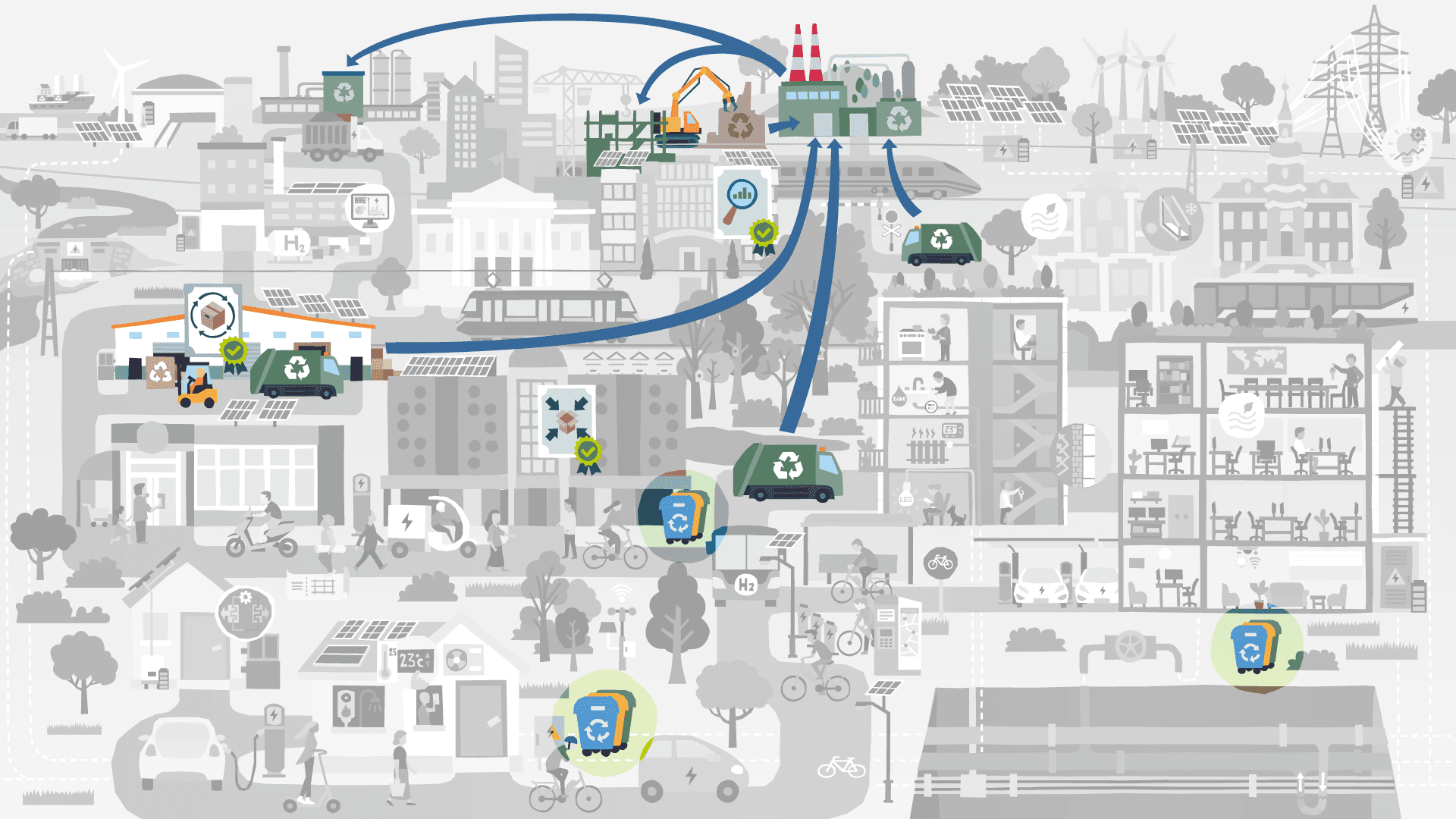
This page provides an overview of resources on the topic of waste management and circular economy, with typologies of solutions and cases from Mission Cities

Waste and Circular Economy
Adopt a circular economy approach to cut emissions from city generated waste by minimising the use of virgin resources and reducing waste, pollution and carbon emissions. Promoting a sustainable resource use through enhanced waste and water management, recovery critical raw materials, efficient construction practices, extended water lifecycles, optimised energy use and reduced food waste via sustainable methods and alternative proteins.
Reading Resources
JRC Collection
The Joint Research Centre has produced a collection of documents to help cities identify how to mitigate greenhouse gas emissions.
The Circular Design of Buildings - Circular Toolbox
Circular building deaign uses fewer materials and makes buildings last longer and easier to reuse, helping reduce waste ans costs
Green Guide for festivals and events: inspiration from North Jutland
These initiatives focus on reducing food waste and resource consumption at events by improving planning, promoting plant-based and local food, and redistributing surplus food through partnerships.
Gliwice, Poland - case studies - Intelligent Cities Challenge
These initiatives focus on improving resource efficiency by recovering waste heat and reducing energy losses, helping lower emissions and make better use of existing energy.
Kalamata, Greece case studies - Intelligent Cities Challenge
These initiatives reduce waste by promoting recycling, composting, and reusable alternatives, while encouraging more sustainable consumption and reducing single-use plastics.
Larissa, Greece case studies - Intelligent Cities Challenge
These initiatives reduce plastic waste by promoting refill stations and reusable bottles, replacing single-use plastics with more sustainable options.
Legnano, Italy case studies - Intelligent Cities Challenge
These initiatives focus on improving waste management in micro, small, and medium-sized enterprises by enhancing plastic packaging collection, increasing recycling, and supporting businesses in adopting more sustainable practices.
Nicosia, Cyprus case studies - Intelligent Cities Challenge
A compilation of initiatives focused on reducing waste by training hospitality staff in better waste and energy practices, and promoting local composting systems to turn food waste into useful resources.
Futures deepdive - AI Towards Carbon Neutrality
Artificial Intelligence can help cities reduce emissions, but it also has risks, so it should be used together with policies and behavioural changes rather than as a complete solution
Capacity building and engagement with municipalities to identify and co-create circular solutions and roadmaps
Capacity building helps cities learn, plan, and work together with stakeholders to create and implement circular solutions and long-term sustaianbility roadmaps
Analysis of City/ (Building) circularity
Emission-free building systems analyse and reduce emissions from construction and materials across the whole life cycle, helping make buildings more sustainable and efficient.
Circular economy design principles to increase the durability, reparability, upgradability or reusability of products
Circular design means creating products that last longer, can be repaired, reused or adapted, helping reduce waste and use fewer resources
Circular Life Cycle Assessment/Analysis for material and products
CIrcular Life Cycle Assessment (LCA) studies the environmental impact of a product or system from raw materials to reuse or recycling, helping improve sustiability and decision-making.
Muncipal solid waste separation at source: pay as you throw
The "pay as you throw" system meand people pay based on how much waste they produce, encouraging them to reduce waste and recycle more
Textile and fashion design for circularity
Circular textile design focuses on creating durable, recyclable and low-impact products by improving materials, production processes and business models across the whole lifecycle, supported by digital tools and innovative materials.
Circular packaging: Reducing demand for (over)packaging/ packaging waste, improved circular design and strategies that fully replace the need for packagin
Circular packaging aims to reduce material use, shift from fossil-based to renewable materials, and improve recyclability through more efficient and simplified design (e.g. using monomaterials).
Re-using local building waste (e.g. local waste material bank)
Reusing local construction waste uses nearby materials again to reduce waste, save resources and lower emissions in buildings.
Construction and Building: online register with building and infrastructure material/parts/products for reuse/circular use
Online material registries store data about building materials to enable reuse, reduce waste and support circular construction.
Circular Economy Life Cycle Costing (CE-LCC)
CE-LCC is a tool that calculates building costs over time, including reuse, repair and recycling, to help choose better circular design options.
Grey water treatment (including Nature Based Solutions) and reuse
Greywater treatment reuses household water for toilets or irrigation, reducing water use and waste.
Waste and circular economy
Cities are key to the circular economy, reducing waste and resource use by reusing materials, improving recycling, and managing resources more efficiently across sectors.
Concept: Industrial symbiosis
Industrial symbiosis connects different industries so they can use each other’s waste as resources, reducing waste and improving efficiency.
Concept: Water-Energy-Food-Ecosystem (WEFE) Nexus approach
The WEFE Nexus approach connects water, energy, food and ecosystems to manage them together and improve sustainability and resilience in cities.
Food and Nutrient Recycling
Food waste can be reused to create new products, energy or useful materials instead of being wasted.
Product labelling for circularity/durability/reparability
Product labels help people choose better, use products longer and recycle waste correctly
NZC Policy Brief - Circular Economy
EU circular economy policy framework addressing construction waste and plastic reduction.
Innovation Watch #2 - Sustainable building heating
Industrial circular economy approach using waste as a resource through recycling, by-product exchange, and material reuse
Pacto Verde Local Los Polígonos- Industriales Reducen las Emisiones mediante la Economía Circular
Molina de Segura industrial circular economy initiative connecting companies to reuse waste and reduce emissions
(Online Planning Lab - Module 4 Spotlight 5 slides) Spotlight session 5: Scope 3 and other emission domains
City-level food actions reducing emissions through plant-based diets, waste reduction, and sustainable sourcing.
Electrified urban freight delivery / Last mile delivery
Presents electrified last-mile delivery solutions such as cargo bikes and electric vans, supported by modelling tools to assess emissions and logistics efficiency.
Innovation Watch #1 - Urban e-mobility
Showcases emerging urban e-mobility innovations including EV charging, V2G, logistics hubs, and policy instruments like LEZs.
Concept: Eco-districts / Green neighbourhoods
As it happens with some other subsets of sustainability term or its application (i.e.: climate-neutral city, smart-sustainable city), there is not unique and clear definition for the eco-district term. Generalist definitions describe an eco-district as an urban development aiming to deploy the objectives of sustainable development, focusing on integrating environmental, social and economic goals.
Encompassing the full value chain of producing food for human consumption – valorisation of low value fish species
There is a global need to find and use alternative protein sources in order to improve the sustainability of the food system. While alternative proteins are studied, the easiest shift in the consumers' diet is to exchange meat with fish intake. Nevertheless, this higher consumption must be done avoiding overfishing and improving the current catching processes: The solution can be to adopt a production concept (fish farms) that uses diverse whole (ungutted) fish as raw material for convenient palatable seafoods.
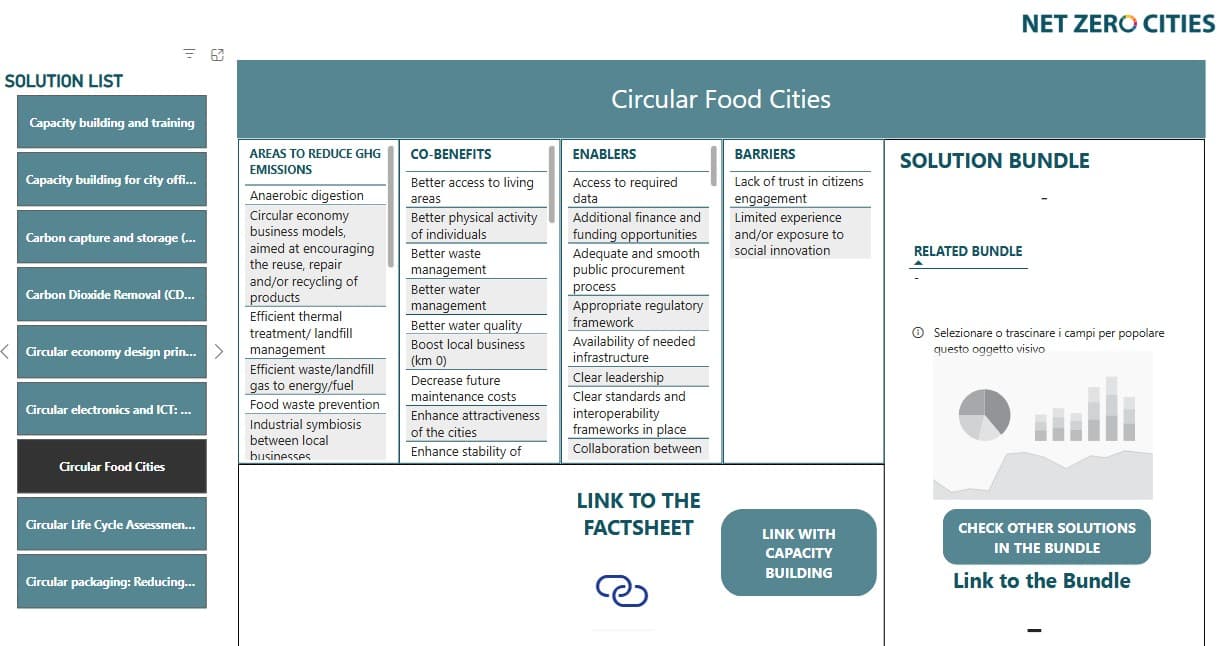
Circular Food Systems
As cities around the world are growing, we need to find new ways to feed growing urban populations. Our current linear food system is wasteful, inefficient, and resource-intensive. Roughly a third of the food produced worldwide is wasted and ends up in landfills, creating harmful greenhouse gas emissions. Cities (and their peri-urban regions) can take on a leading role in creating sustainable and circular food systems with better waste management.
Guarantee the energy saving/production in buildings
Different service providers offer services to help customers improve their buildings energy performance. These are typically called energy service companies (ESCOs). They can help achieve energy savings by implementing energy-efficiency and renewable energy projects.
Waste to energy in buildings
Grinded Bio Waste and Blackwater (water from toilets or kitchens) generated in households can be treated in Anaerobic Membrane Bio-Reactors (AnMBR) for the recovery of treated blackwater, compost, and renewable energy. Absorption technologies can be used to ensure biogas quality.
Production of biofuel based on black liquor from the paper industry
Black Liquor is a by-product of pulp from mills that make products from trees, such as paper. It is currently used to recover cooking chemicals and produce high-pressure steam used in the pulp and paper-making process. It is composed of different ingredients from these processes such as lignin, hemicellulose, sodium hydroxide (NaOH) and sodium sulfide (Na2S).
Efficient treatment and reuse of un-segregated water at building level
Solid and liquid/solid free waste fractions generated in households can be separated for further valorisation. Separation technologies include commercial mechanical techniques as screw press or decanting centrifuges. Once separated, the solid fraction can be converted into biogas in an anaerobic digestion unit to be used within the building.
Greywater and rainwater reuse at building level
Greywater is the wastewater generated in households or office buildings without serious contaminants, such as water from baths, sinks and washing machines. Greywater can be separated from blackwater (water from toilets or kitchens) and then treated on-site for direct reuse in toilets recharge or irrigation. Greywater is a relevant secondary source of water and nutrients. Many studies have analysed the environmental, economic, and energetic benefits of the reuse of greywater.
Reduction of raw materials, waste and integration of secondary materials
The necessity for urban transformation towards a circular economy (CE) system is becoming more evident as urban population and waste generation are increasing. To face this challenge of decoupling the economy from natural resources extraction, the cities need to adhere to several programs and strategies established by national, regional and municipal levels such as CE Action Plans. Local policy makers can make public local commitment to tax and regulatory reforms, or promote legislation adaptation, prescribing green public procurement etc.
Construction and buildings: Circular Life Cycle Cost (C-LCC) for deep renovation
The Circular Economy Life Cycle Cost (CE-LCC) model is an economic assessment model for the building sector. It is based on current Life Cycle Cost analysis, which calculates the total cost of a product from cradle to grave (such as sales price, use price, and disposal costs) to support decision-making processes during the development of products.
Construction and Buildings: online register with building and infrastructure material/parts/products for reuse/circular use
The built environment industry mostly follows a linear economy model: from extraction of non-renewable virgin materials, through manufacturing and constructing, to disposal in landfills. Registration and documentation of products and materials used in the built environment can help the transition to a circular economy, encouraging their reuse and eliminating waste, thus reducing the negative environmental footprint of the building sector.
Construction and Buildings: Residual Value Calculator
Currently, there is a widespread lack of awareness on the economic value of building products and components deriving from renovation, repurposing or change of layout in buildings. Especially in office and commercial buildings, the design might change the interior materials many years before technically necessary, leading to unnecessary waste.
Construction and Buildings: urban mining model to assess circular construction opportunities and optimize resource use and exchange
Urban mining is the process of recovering and reusing materials of existing buildings. An Urban Mining Model is about preserving stock of materials present in existing buildings. It is an applied contribution towards stepping-up of circularity in the housing construction sector with a focus on optimal re-use of secondary building materials and, at the same time, reduction of CO2 relates to the use of new building materials. For city governments in particular, this model shows different possibilities for re-use based on aspects such as quality, residual value, environmental impact and logistical implications.
Construction and Buildings: re-using local building waste
Currently, the construction sector is mostly following linear economy principles – consuming non-renewable virgin materials, producing landfill waste, and producing an overall negative environmental impact. The construction industry is the biggest global consumer of resources and raw materials, consuming e.g., roughly 50% of the total steel production. In addition, 3 billion tonnes of raw materials are used yearly to manufacture building products worldwide. In Europe, the construction and demolition waste is the biggest waste stream (measured in weight), accounting for 32% of the total waste generated. In addition, the construction sector is energy intensive and thus generates CO2 emissions. To mitigate these problems, a transition to a circular economy model is needed.
Construction and Buildings: Optimal management of waste at the end of building life cycle
Currently, at the end of a building’s life the majority of its materials are sent to landfill or down-cycled into products of much lower value. To maximize the recovery and valorisation potential of existing materials in buildings and minimize waste in construction, optimal waste management at the end of life of buildings is essential. The right treatment and disposal of materials at the end of life can significantly reduce the construction sector’s environmental footprint.
Circular packaging: Reducing demand for (over)packaging/ packaging waste, improved circular design and strategies that fully replace the need for packaging
There is a clear need to decrease usage of non-renewable raw materials in many applications including packaging. In packaging this means usage of renewable raw materials and decreasing the amount of used packaging material. Target is to produce materials from renewable raw materials that can be used as packaging materials.
Plastics: Expanding the use of bio-based and compostable materials
Currently, the share of the bioplastics from the overall global plastics production is only 1% (2.1Mt), and it is applied largely for packaging solutions. Globally, sustainability strategies of different countries include replacement of fossils with renewables, however, this intended increase in biomass use will potentially lead to trade-offs that need to be studied.
Plastic waste management
Plastics are among the key sectors identified in the EU Circular Economy Action Plan. The need for solutions that promote circularity in this sector will be increasing as their consumption is expected to double in the coming 20 years.
System level circular economy approaches in batteries
The transition to a low-carbon economy will lead to an exponential increase in demand for batteries and raw materials for batteries (such as lithium, cobalt, nickel and manganese) - this supply risk could at least partially be reduced by system level circular economy (CE) approaches.
Circular electronics and ICT: New processes & strategies for the recovery of Critical Raw Materials
A variety of new technologies and waste recovery systems are being developed in response to European legislation and market forces that aim to recover critical raw materials (CRM) from end-of-life appliances. These diverse resource recovery processes are often regrouped under the concept of “urban mining”, which considers cities’ waste streams as economically important reserves of metals needed for digital and low-carbon technologies.
Circular textiles: Urban recovery and processing techniques, waste to feedstock optimization
Circular design of textiles involves designing textiles in ways that make them last longer, create less waste during their entire life-cycle, are made from non-toxic material and can be recycled.
Urban biodegradable waste for compost
Urban biodegradable waste refers to waste from gardens and parks, food waste from households, restaurants, food services, and markets, as well as waste from food processing, excluding waste from forestry or agriculture, textiles, wood, or paper. Across the EU, between 118 and 138 million tons of biodegradable waste are generated each year, which makes up almost half of municipal solid waste. Urban biodegradable waste discarded in landfills poses a major threat for the environment as its decomposition releases harmful methane into the atmosphere.
Municipal Solid Waste treatment: Anaerobic digestion for biogas production
The anaerobic digestion of the organic fraction of municipal solid waste (OFMSW) is a common process implemented throughout the world as it offers a sustainable source of biogas while valorising municipal waste. Anaerobic digestion also produces digestate, a nutrient-dense mixture that can be used by farmers as a high-quality fertilizer:
Municipal Solid Waste separation at source: pay as you throw
Pay as you throw (PAYT) is policy instrument that charges citizens for the amount of waste they produce, so the Municipal Solid Waste (MSW) services are considered as an utility. It is often linked with the purchase of trash bags directly by the citizens, usually marked with a code.
Case Studies
Guimarães: From Cradle of a Nation to Cradle of Innovation
-
Malmö’s bold road to climate neutrality: A model for systemic change
-
Drammen’s zero-emission mosaic for 2030
-
Scaling Reuse Through a Pop-up Recycling Store
Uppsala initiative scaling construction material reuse through a pop-up recycling store and material recovery system
Glasgow: data-driven net zero and circular transition
Glasgow Circular Economy Routemap aligning city stakeholders to implement circular actions by 2030.
Pécs: Climate Governance, Circular Economy and Urban Decarbonisation
Pécs Market Hall initiative to phase out single-use plastic bags through reusable alternatives, incentives, and consumer awareness.
Prato: Circular economy solutions & urban governance in a highly industrialised textile city
Prato mechanical textile recycling model focused on SMEs
Digital Platform for "Donor Buildings
Drammen construction waste reuse platform example
Learning from Cities
A map is loading