Solution Themes
image

Transforming urban mobility is one of the most critical steps toward achieving climate neutrality. Reimagining how people and goods move through our cities requires a systemic approach that goes beyond simply upgrading vehicles. This section brings together EU-specific learning resources, practical toolkits, and case studies to help you navigate the transition. Dive in to learn how to deploy systemic levers, from behavioural shifts to policy incentives, that make sustainable transit the new normal in cities


location_pin
Mobility and Transports

Transforming how people and goods move is a cornerstone of the transition to climate neutrality. This specialized section of the NetZeroCities Learning Hub is dedicated to sustainable mobility and transport, providing public administrators, urban planners, and climate practitioners with the essential knowledge and actionable strategies required to deeply decarbonise urban mobility.

Recognising that achieving net-zero emissions requires a holistic shift, these resources dive into the intersection of technology, infrastructure, policy, and human behaviour. You will explore evidence-based cases and innovative tools designed to accelerate the adoption of zero-emission public transport, build robust networks for active travel (such as walking and cycling), optimize urban freight, and integrate smart transit technologies. By bridging theory with practical examples, this section aims to support the transition from fossil-fuel vehicles to clean, efficient an equitable transport systems in cities.

Sub Topics
Measures and policies that influence how, when, and why people travel, with the aim of reducing private car dependence and encouraging more efficient, sustainable transport choices.
Explore Resources
item-icon
81 Summaries/Factsheets on Aspects of Transport Planning
item-icon
item-icon
Exploring shared mobility solutions- Vitoria-gasteiz, spain
item-icon
item-icon
Sustainable Urban Mobility Castelo Novo, Municipality of Fundão, Portugal
item-icon
item-icon
Greening public transport - Taurage, Lithuania
item-icon
item-icon
Multimodal MaaS Mobility Platform - Kranj, Slovenia
item-icon
item-icon
Driving Sustainable Commuting Practices Lahti, Finland
item-icon
item-icon
Tackling Congestion - Bordeaux Metropolitan Area
item-icon
item-icon
Decarbonising transport with Ultra-Low Emission Zones in London
item-icon
item-icon
Reducing the climate impact of mobility in Porto
item-icon
item-icon
Towards low carbon transport in Prague
item-icon
item-icon
Gender diversity considerations in urban mobility
item-icon
item-icon
Multimodal ticketing
item-icon
item-icon
FRONTIER Factsheet #2 - FRONTIER ANTME Platform
item-icon
item-icon
Road/congestion pricing in transport
item-icon
item-icon
Mobility management
item-icon
item-icon
City Dashboards
item-icon
item-icon
Innovation Watch #1 - Urban e-mobility
item-icon
item-icon
Low-emission Zones
item-icon
item-icon
Mobility and Transport
item-icon
item-icon
Integrated land use planning and urban space management with mobility planning
item-icon
item-icon
Sustainable Urban Mobility Plan (SUMP)
item-icon
item-icon
Ride Sharing Service in Helsinki
item-icon
item-icon
Intelligent Transport Systems Infrastructure
item-icon
item-icon
Urban Vehicle Access Regulations (UVAR)
item-icon
item-icon
Multimodality
item-icon
item-icon
Smart cards
item-icon
item-icon
Parking policies, management and fees, smart parking
item-icon
item-icon
Cooperative Intelligent Transport Systems and Services (C-ITS)
item-icon
item-icon
Mobility as a Service (MaaS)
item-icon
item-icon
Collective passenger transport
item-icon
item-icon
Shared micromobility
item-icon
item-icon
Car sharing
item-icon
item-icon
Mobility hubs
item-icon
item-icon
Public charging system for EVs
item-icon
item-icon
Cooperative, connected and automated mobility (CCAM)
item-icon
item-icon
Scenario-based analysis (Mobility & Energy - One Model)
item-icon
item-icon
Predictive Modelling
item-icon
Emissions and mobility impacts linked to rail, air, and waterborne transport modes, including passenger and freight movement by trains, aircraft, ferries, ships, and other vessels.
Emissions from large freight vehicles that move heavy goods over longer distances and typically have higher fuel use and more difficult decarbonisation pathways.
Actions that reduce the need for trips in the first place, for example through better land-use planning, digital services, remote access, or locating homes, jobs and services closer together.
Videos
Reading Resources
Gender diversity considerations in urban mobility
Highlights gender-inclusive mobility planning using data-driven and participatory approaches to improve accessibility, safety, and equity in urban transport systems.
Multimodal ticketing
Describes multimodal ticketing systems that integrate transport services into unified payment platforms, improving accessibility and user experience.
FRONTIER Factsheet #2 - FRONTIER ANTME Platform
Presents the FRONTIER ANTME platform using AI and real-time data for automated traffic management and multimodal optimisation.
Good delivery with drones
Explores drone-based delivery systems for sustainable urban logistics, including operational models, regulatory considerations, and emission-reduction potential.
Urban Air Mobility
Explains Urban Air Mobility (UAM) systems using electric aircraft and drones for transport and logistics, including infrastructure and regulatory frameworks.
Road/congestion pricing in transport
Introduces congestion pricing as a policy tool to reduce traffic and emissions by influencing travel behaviour and promoting modal shift.
Mobility management
Defines mobility management as a behavioural-change strategy using soft measures like awareness campaigns, travel planning, and stakeholder engagement to reduce car use and support sustainable mobility.
Zero emission vessels - Reduce emission in ports
Provides an overview of zero-emission waterborne transport solutions for port cities, including electrification, alternative fuels, and infrastructure strategies to reduce maritime emissions.
Hydrogen as a fuel in urban transport
Provides an overview of hydrogen as a clean fuel for urban transport, including fuel cell applications, infrastructure needs, and integration into energy systems.
Intelligent transport systems infrastructre
Describes Intelligent Transport Systems (ITS) infrastructure using ICT, AI, and IoT to improve traffic management, safety, and energy efficiency.
Scenario-based analysis (Mobility and energy - one model)
Explains scenario-based modelling tools for evaluating mobility and energy interventions through integrated simulations of environmental and spatial impacts.
City Dashboards
Explains city dashboards as digital tools for monitoring urban indicators such as emissions, traffic, and air quality to support data-driven decision-making.
Electrified urban freight delivery / Last mile delivery
Presents electrified last-mile delivery solutions such as cargo bikes and electric vans, supported by modelling tools to assess emissions and logistics efficiency.
Urban rail
Highlights the role of electrified urban rail systems in reducing emissions and enabling multimodal transport, including innovations in automation, digitalisation, and infrastructure efficiency.
Innovation Watch #1 - Urban e-mobility
Showcases emerging urban e-mobility innovations including EV charging, V2G, logistics hubs, and policy instruments like LEZs.
Concept: 15-minute city
Introduces the 15-minute city concept, promoting proximity-based urban planning to reduce car dependency and improve accessibility and livability.
Low-emission Zones
Explains Low-Emission Zones (LEZs) as regulatory tools to limit high-emission vehicles, improving air quality and supporting phased urban decarbonisation strategies.
Urban Vehicles Access Regulation (UVAR)
Describes Urban Vehicle Access Regulations (UVARs) such as low-emission zones and congestion charges to reduce traffic, emissions, and improve air quality and urban liveability.
Public charging systems for EVs
Explains how to design and implement public EV charging infrastructure, including interoperability, smart charging, grid integration, and policy tools for scaling zero-emission mobility in cities.
Mobility and Transport
Presents a comprehensive framework (Avoid–Shift–Improve) for decarbonising urban transport, combining policy instruments, electrification, and behavioural change strategies for integrated mobility planning.
Integrated land use planning and urban space management with mobility planning
Explains integrated land-use and mobility planning to reduce car dependency, support modal shift, and enable 15-minute city concepts through multimodal, people-centered urban design. Useful for planners aligning transport, accessibility, and spatial development strategies.
Sustainable Urban Mobility Plan (SUMP)
Explains Sustainable Urban Mobility Plans (SUMPs) as strategic tools for integrated, participatory, and long-term mobility planning aligned with EU climate and policy frameworks.
Concept: Eco-districts / Green neighbourhoods
As it happens with some other subsets of sustainability term or its application (i.e.: climate-neutral city, smart-sustainable city), there is not unique and clear definition for the eco-district term. Generalist definitions describe an eco-district as an urban development aiming to deploy the objectives of sustainable development, focusing on integrating environmental, social and economic goals.
Assessment Framework for People-Centred Solutions to Carbon Neutrality
RESOURCE SUBHEADING Discover how other cities are driving change with our interactive map. Explore country-specific resources, including best practices, action plans, pilot programs, and case studies. \n Zoom in to the map to discover resources! You can filter them by the Levers of Change on top, and click on each dot to discover each resource in detail.
Intelligent Transport Systems Infrastructure
The EC Communication on a European strategy on Cooperative Intelligent Transport Systems acknowledges the key role of digital technologies in the current transformation of the transport sector. Intelligent Transport Systems (ITS) apply information and communication technologies such as journey planners, eCall (a system that automatically alerts emergency services in case of an accident), short-range communications for improving passenger safety and reducing road fatalities, and connected and automated mobility concepts for passenger and goods. Their aim is to make mobility safer, more efficient and more sustainable
Multimodality
To encourage and facilitate a shift from private vehicles to more environmentally-friendly means of transport, all means of transport need to be considered when planning for citizens’ mobility needs. Within the last years, many innovative mobility solutions, like on-demand services, shared mobility & micro-mobility or even automated services have emerged in European cities and have disrupted the conventional mobility system that is shaped by mono-modal transport.
Multimodal ticketing and smart cards
Public transport companies have different types of tickets, providing a variety of services, from single tickets (one-journey ticket, zonal or origin-destination tickets) to single-modes and multi-modes tickets (combining multiple operators), etc. To facilitate boarding and transaction but also the integration of different modes under one card or system, transport authorities are pushing moving towards electronic ticketing, multimodal ticketing and smart cards.
Smart cards
Smart cards can be defined as a device, generally bank card size, made of an embedded integrated circuit, encapsulated in a plastic body. The contactless smart card communicates with and is powered by the reader through radio-frequency (RF) induction technology, within a few centimetres distance.
Parking policies, management and fees, smart parking
Stakeholders, such as city authorities, companies, experts and planners have to make various complex decisions in the urban planning process, with designing sustainable and future-proof road infrastructures being one of the many complicated tasks. An example includes design decisions for scope and suitable locations for parking and choosing appropriate tariffs.
Cooperative Intelligent Transport Systems and Services (C-ITS)
Cooperative Intelligent Transport Systems (C-ITS) characterises the more modern version of ITS where communication among vehicles using wireless technology is possible, which enables them to interact not only with each other but also with the road infrastructure and even with pedestrians or cyclists. Such functionalities enable a coordination and cooperation between road users, which allow for the advanced management of traffic and mobility, and can serve as technological basis for new mobility solutions (e.g. CCAM, MaaS).
Mobility as a Service (MaaS)
The number of mobility services is growing rapidly, yet for the user it can be challenging to confront all these options when choosing the best way to travel. This is where the Mobility as a Service (MaaS) concept steps in: MaaS is about taking away the hassle of finding the most suitable mobility option. It plays a role to change mobility habits by providing travellers with multiple transport options under one system. From a transport perspective, Maas is offering better services with a wide range of options, therefore attracting more customers.
Collective passenger transport
Defining Collective Passenger Transport Categories and Responsive Mobility Solutions.
Shared micromobility
Shared micromobility is “the shared use of a bicycle, scooter, or other low-speed mode enabling users to have short-term access to an active or low-speed motorized transportation mode on an as-needed basis” (IGI Global).
Car sharing
Owning and operating a personal vehicle in cities is becoming increasingly inefficient and costly. Car sharing systems provides access to a car for users who might not own a car, because they do not need it for daily journeys or cannot afford a private vehicle. They can also be used by companies and authorities for their fleet management.
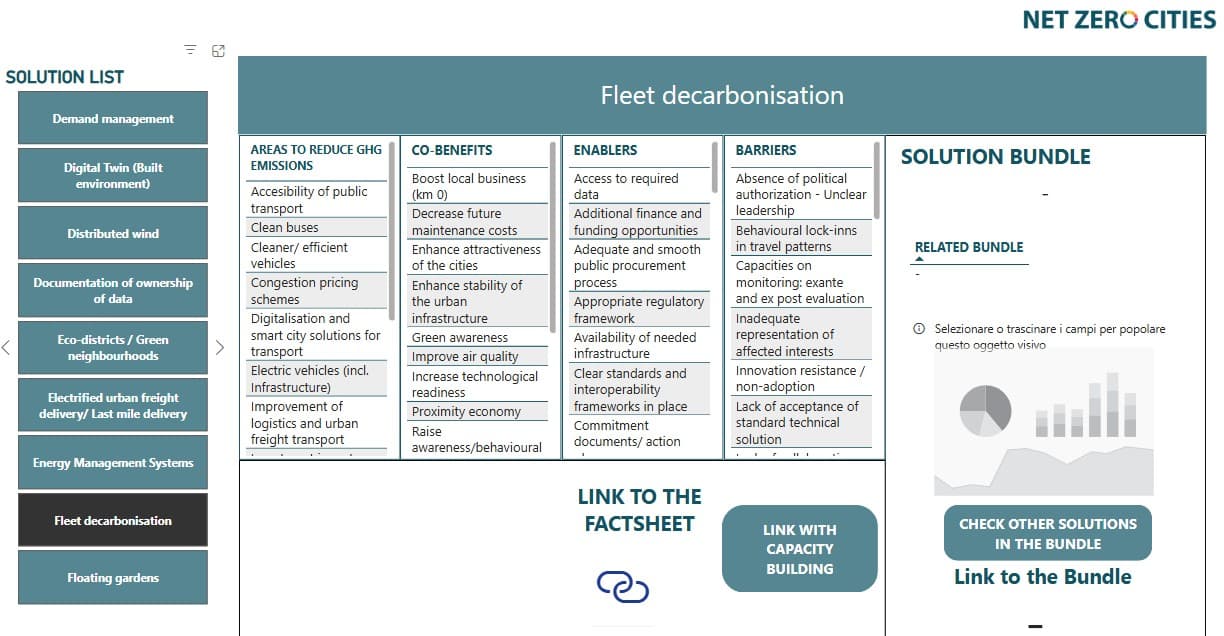
Fleet decarbonisation
Commercial fleet is a group of vehicles utilized by a company to pursue its business objectives, regardless of whether persons or freight are being transported. Any type of vehicle can be included in the commercial fleet; however, aviation, shipping and road freight transport are deemed the most difficult sectors to decarbonise.
Electrified urban freight delivery/ Last mile delivery
Electrified urban freight delivery and other sustainable options for last mile delivery can be promising climate and energy solutions to reduce emissions coming from logistics, in the effort to contribute to low-emission zones as these are now envisaged in a number of cities. Solutions such as shifting to electric vans, micro-depots with zero-emission last-mile deliveries, cargo bikes, or even implementing a hub for a certain freight flow can be developed for various sub-sectors within urban freight (e.g. retail, parcels, etc.).
Goods delivery with Drones
Following the success of Unmanned Aircrafts, UAs (drones) in surveillance and remote sensing, drone delivery systems have begun to emerge as an alternative to trucks and vans for handling last-mile delivery. Drone delivery solutions are expected to reduce delivery costs, delivery time, congestion, GHG and local emissions in urban areas and hence free up space at ground level to create healthier, livable cities.
Mobility hubs
Mobility hubs provide a focal point in the transport network that seamlessly integrates different modes of transport, multi-modal supportive infrastructure, and turn spaces into places. It is designed and spatially organised in a way to facilitate access to transport modes and easy transfer between the modes, from rail, to buses, shared cars, shared bikes, and/or shared e-scooters, ride-hailing/shared taxis.
Fostering walking
Walking is the most basic, democratic and space-efficient form of transport and is open to people of all age groups and socio-economic circumstances. As a mode of transport (as opposed to walking for leisure), walking needs to be considered both as the beginning and end of every trip by any other mode and as a mode of transport itself for short distances.
Fostering cycling
Cycling has recently become more popular (and is being taken more seriously) as a sustainable urban mobility solution. Cycling is at least part of the solution to multiple urban problems. Cycling can reduce the number of serious injuries and traffic deaths, reduce energy consumption, make efficient and equitable use of space, improve personal health, support local economies and improve social inclusion. It also reduces noise pollution and increases the freedom and independence of children (and of their parents).
Bi-directional EV charging (V2X)
Vehicle-to-everything (V2X) is a technology that enables bidirectional charging possibility between vehicle battery to many different use cases such as homes, buildings, services, factories, power grids, or even another vehicle. V2X is often considered as a solution for emergency power supply in the event of a power outage or, especially in case of vehicle-to-grid (V2G) for inevitable grid problems when the peak energy demand is higher than the supply capacity of the grid.
Cooperative, connected and automated mobility (CCAM)
Connected, Cooperative and Automated Mobility (CCAM) refers to the development of user-centered, inclusive and shared mobility concepts, for people and goods, that are based on automation and connectivity. These innovative mobility concepts aim to complement and integrate the EU transport system with the aim to make it safer, smarter and more sustainable.
Hydrogen Fuel Cell Electric Vehicles (FCEVs) in urban transport
Hydrogen used as a fuel has emerged as an alternative fuel with multiple benefits. It is commonly used in its gaseous form to power a fuel cell, generating electricity, where it is completely emission free at point of use, with zero tailpipe emissions. Fuel cells are especially useful in-vehicle applications where the energy and power density of batteries is not sufficient, with also the advantage of low refuelling times.
Zero emission electric cars
An electric car uses electric power instead of an internal combustion engine powered by liquid or gaseous fuels like diesel fuel, gasoline, LPG or methane. It has been increasingly recognized that electric cars provide an opportunity to reduce global GHG emissions and greatly increase air quality.
Zero emission buses
Buses are an integral part of urban public transport systems. However, urban buses are responsible for about 8% of the road transport Green House Gas emissions in EU [8]. Buses with internal combustion engines are responsible also for emissions of fossil carbon dioxide (CO2) as well as air pollutants particulate matter (PM) or nitrogen oxides (NOx). Thus, zero emission buses, have a significant potential in the reduction of transport related emissions in urban area
Scenario-based analysis (Mobility & Energy - One Model)
Decision making in the urban environment is typically performed using a scenario-based analysis. Stakeholders define a base scenario, which serves as the current situation in a city. Additionally, a reference scenario in which e.g. a road is closed can be defined to study the effects of the closure and make a comparison with the base scenario.
Zero emission buses (electric and fuel cell)
Buses are an integral part of urban public transport systems.
Case Studies
Guimarães: From Cradle of a Nation to Cradle of Innovation
-
Malmö’s bold road to climate neutrality: A model for systemic change
-
Ioannina: Local groups collaborate for climate neutral zones
Shows co-creation of climate-neutral zones in Ioannina integrating mobility, buildings, and nature-based solutions.
Exploring shared mobility solutions- Vitoria-gasteiz, spain
Demonstrates car-pooling pilot in Vitoria-Gasteiz reducing commuter emissions through incentives and shared mobility.
Sustainable Urban Mobility Castelo Novo, Municipality of Fundão, Portugal
Presents rural electric mobility service in Fundão connecting villages with rail infrastructure to improve accessibility.
Cycling Superhighways - Oulu, Finland
Shows development of cycling superhighways in Oulu to enable year-round active mobility and modal shift.
Greening public transport - Taurage, Lithuania
Demonstrates electrified and free public transport system in Tauragė improving accessibility and reducing emissions
Multimodal MaaS Mobility Platform - Kranj, Slovenia
Demonstrates MaaS platform implementation in Kranj integrating digital tools and multimodal transport systems.
Driving Sustainable Commuting Practices Lahti, Finland
Shows Lahti’s employer-based commuting interventions to reduce emissions through behavioural change and incentives.
Busto Arsizio, Italy case studies - Intelligent Cities Challenge
Demonstrates integrated mobility solutions in Busto Arsizio combining logistics, DRT, and behavioural change tools.
Galați, Romania case studies - Intelligent Cities Challenge
Presents electrification of taxi and public transport fleets in Galați through Local Green Deals and infrastructure deployment.
Tackling Congestion - Bordeaux Metropolitan Area
Describes Bordeaux’s cycling network expansion to reduce congestion and promote active mobility through large-scale infrastructure investment.
Superblocks (Vitoria-Gasteiz)
Shows implementation of superblocks in Vitoria-Gasteiz to reduce traffic, improve public space, and promote active mobility.
Decarbonising transport with Ultra-Low Emission Zones in London
Demonstrates London’s Ultra-Low Emission Zone (ULEZ) reducing emissions and improving air quality through regulatory transport policies.
Reducing the climate impact of mobility in Porto
Describes Porto’s mobility decarbonisation strategy including fleet electrification, public transport investment, and pricing incentives.
Towards low carbon transport in Prague
Presents Prague’s integrated low-carbon mobility strategy combining electrified transport, infrastructure expansion, and urban planning measures.
Blended Finance - BABLE Solutions: Smart Cities, EUROPE
Explains a blended finance model for deploying electric mobility infrastructure through joint procurement and private investment aggregation.
The Green Participatory Budget: Lisbon, PORTUGAL
Describes Lisbon’s Green Participatory Budget enabling citizen-driven funding of climate and mobility projects such as green corridors and cycling infrastructure.
Financing of the transport sector in Graz
Presents Graz’s investment strategy combining public transport electrification, cycling infrastructure, and financing mechanisms for decarbonisation.
FEBUS, a success story of fuel cell buses deployment - Covenant of Mayors Europe
Demonstrates hydrogen-powered bus deployment in Pau, showcasing infrastructure, financing, and emission reductions in public transport systems.
Ride Sharing Service in Helsinki
Ride sharing service initiated by local football club PPJ started from an agile pilot and became a permanent activity in the club. After school, school children get transported from school to football training on a minibus.
Showcase
showcase imageOpen tool
Learning from Cities

A map is loading