
NZC Systems Perspectives
image
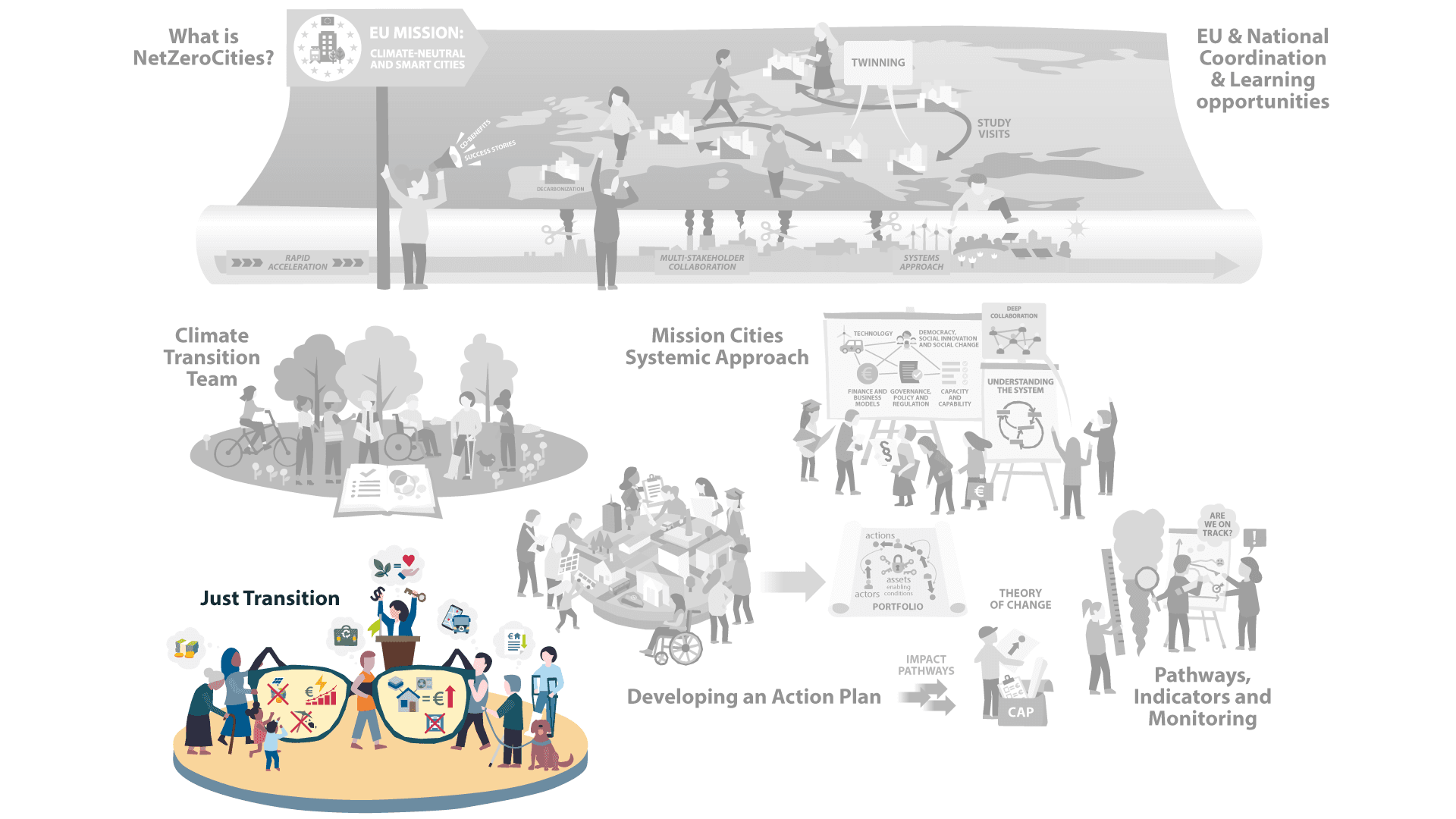
A Just Transition is an approach for a strategically planned process to ensure that the transition to decarbonisation (of cities, territories and the economy) is also a transition away from practices that are harmful to people and ecosystems and towards models that are more sustainable and equitable for all.
location_pin
Just transition

A Just Transition is an approach for a strategically planned process to ensure that the transition to decarbonisation (of cities, territories and the economy) is also a transition away from practices that are harmful to people and ecosystems and towards models that are more sustainable and equitable for all.
How Can Cities Ensure a Just and Inclusive Climate Transition? 

  • Recognise the risks faced by vulnerable groups due to climate change impacts, as well as policies and actions that may exacerbate inequalities.  
  • Apply a Just Transition perspective to their climate strategy and climate actions (processes, policy), 
  • Understand how this influences decisions related to climate governance, stakeholder engagement, and decision-making in climate action
Videos
Reading Resources
C40 Achieving the just transition: A toolkit for city leaders across the globe

Practical toolkit for mayors and city teams setting out how to embed equity, governance, finance, and delivery considerations in a city level just transition.

Advancing Just Transitions in the Built Environment

Resource on applying just transition principles in the built environment through city cases and recommendations linking decarbonisation, housing, labour, and fairness.

An urban just transition Issue Brief

Concise issue brief framing urban just transition for city leaders and policymakers through key concepts, finance, labour, and multilevel governance.

Climate Equity Toolbox: A how-to guide for making municipal subsidy programs more socially just


Municipal toolbox showing how subsidy programmes can be designed, communicated, and reviewed in ways that better reflect social justice goals.

Embedding Equity Considerations in Sustainable Energy and Climate Action Planning (SECAP)

Guidance on embedding equity across planning, implementation, and monitoring in local energy and climate action processes.

From Incentivizing to Enabling: a practitioner’s guide to equitable climate action in cities

Practitioner guide for cities on designing equitable climate action through stronger community inclusion, institutional change, and more accessible implementation.

C40 Inclusive Planning: Needs Assessment Module

Practitioner resource for identifying equity related needs, barriers, and stakeholder considerations in city climate planning processes.

Positive Narrative for a Just Transition

Resource on framing just transition through positive and politically resonant narratives that connect climate action with legitimacy and public support.

Barriers to action: Gaps in financing for a just transition, social protection, and loss and damage in cities

Report exploring how finance, social protection, and implementation barriers shape the delivery of just transition in cities.

Just sustainability transitions: From concept to practice

Policy oriented resource explaining how justice can move from a broad concept to something embedded in sustainability transition policy and implementation.

Advancing a Just Urban Transition: How the European Commission can support local governments in managing an inclusive and socially fair energy transition

Policy paper on how European level support, funding, and policy can better enable local governments to deliver inclusive and socially fair energy transitions.

Towards a people-centered just transition: The role of cities in advancing the Just Transition Work Programme

Policy paper positioning cities within a people centred just transition agenda through multilevel governance, advocacy, and implementation.

Beyond Inclusion: Equity in Public Engagement

Resource on equitable public engagement that strengthens procedural justice by improving how participation is designed, facilitated, and valued.

Just Transitions Monitoring Guide


Monitoring framework setting out how just transition can be tracked through indicators, targets, data collection, and reporting.

Just transition: An operational framework to make transitions more just

Operational framework translating just transition principles into a structured approach for assessing and shaping transition processes.

Mapping just transition(s) to a low-carbon world

Foundational report mapping different political and conceptual interpretations of just transition across low carbon transformation debates.

Reducing Resource Demand in Climate-Neutral and Just European Cities: Sufficiency as a Policy Tool for Fair and Sustainable Urban Transitions
This NetZeroCities deep-dive report explores how sufficiency can serve as a tool for fair and sustainable transitions in European cities working toward climate neutrality. As research increasingly shows that efficiency and technological innovations alone are insufficient to meet climate neutrality targets, sufficiency complements the strategies by addressing the scale and fair distribution of resource demand and consumption. Sufficiency is understood as meeting people’s needs while staying within planetary boundaries. For cities, it can mean finding ways to reduce demand for energy, materials, land and water while ensuring a good life for a
Day to Day Lifecycle: Infrastructuring democracy
This tool provides a structured framework (“Infrastructuring Democracy” canvas) to plan and embed stakeholder engagement across all phases of an urban project lifecycle. It helps cities and stakeholders design continuous, adaptive participation strategies, linking engagement goals, methods, and timing to strengthen collaboration and improve climate transition project outcomes.
Stitching the City – Valencia as a Laboratory for Democratic Infrastructure
This article explores how a climate crisis in Valencia was used to prototype democratic infrastructure through civic hubs (“Spaces for Encounter”) enabling collaboration between citizens and institutions. It is useful for cities as it offers a replicable model to scale participatory governance and community-led climate action beyond emergency responses.
Just Transition in Practice: Lessons from the Ground
This article synthesises practical approaches to implementing a just transition in cities, drawing on case studies (e.g. Madrid, Barcelona, Valencia, Stockholm) across the built environment, governance, and municipal operations. It is useful for cities working on climate neutrality as it highlights concrete tools (energy communities, public assets, governance frameworks) to integrate social equity, participation, and fairness into climate action.
Meaningful citizen engagement in the climate transition – four lessons from Helsingborg
This article presents four practical lessons from Helsingborg on meaningful citizen engagement in the climate transition, including broadening narratives, multi-channel engagement, cross-departmental collaboration, and the city’s role as an enabler. It is useful for cities working on climate neutrality as it provides actionable strategies to move from participation commitments to effective, inclusive engagement practices that build trust and drive behavioural change.
Accelerating Just Transitions: Insights for Cities and National Platforms
This online repository collects a set of insights that aims to help city representatives and city support agents, such as national platform facilitators, to integrate a Just Transition approach into city climate action.
Bridging the Energy Transition: Energy Communities and Combating Energy Poverty in European Cities
Energy communities embody collective action towards renewable energy adoption, which is integral to achieving the EU’s climate-neutrality goals.
Gender diversity considerations in urban mobility

Factsheet showing how gender, safety, accessibility, and inclusion shape mobility systems and why these dimensions matter in just urban transition.

Case Studies
The Role of Philanthropy in Southern Italy’s Community Energy Transition
-
The Role of Philanthropy in Turin’s Urban Climate Transition
This case study examines the contribution of Fondazione Compagnia di San Paolo to Turin’s pathway toward climate neutrality through two complementary initiatives: the CLICC project and the TPL Carbon Free Innovation Center. Together, these initiatives illustrate how philanthropy can operate both as a builder of systemic urban capacities and as an accelerator of sector-specific innovation. Rather than acting solely as a source of funding, the foundation plays a strategic role in strengthening governance, enabling experimentation and fostering collaboration across institutional and sectoral boundaries.
Paris' Standing Citizens' Assembly
This resource presents the permanent Paris Citizens’ Assembly as a pioneering example of institutionalised deliberative democracy, bringing together 100 randomly selected residents to represent the diversity of the city. It highlights how civic lottery-based assemblies can embed ongoing, representative citizen participation in public decision-making.
Impact Leadership in Espoo
Better Revkjavik
Better Reykjavik is an online platform for the crowdsourcing of solutions to urban challenges launched in May 2010. It is a co-creation project of the Citizens Foundation, Reykjavik City and its citizens that connects them and improves trust and policy.
You Decide (Tú Decides)
You Decide [Tu Decides] is a participatory budget for youth of the Braga City Council.
Learning from Cities

A map is loading