


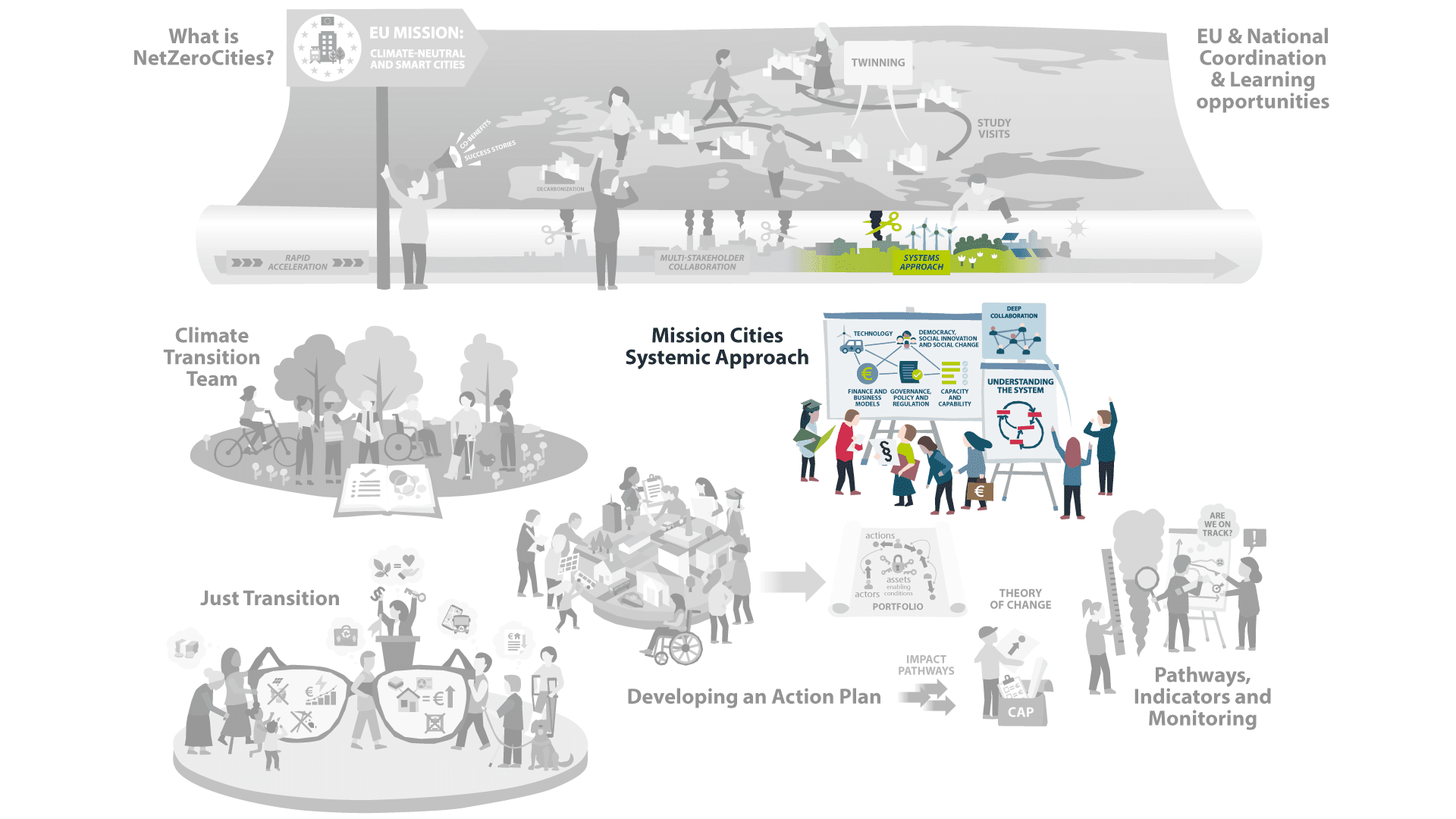
The path to climate neutrality requires more than isolated interventions; it demands a systemic approach that considers the complex, interconnected systems within our cities.

The path to climate neutrality requires more than isolated interventions; it demands a systemic approach that considers the complex, interconnected systems within our cities. Systems innovation laid the groundwork by emphasizing the need to act across multiple sectors, scales and actors. The complexity of today's challenges necessitates an advanced approach — one that integrates portfolio making and embraces distributed governance to manage and steer this complexity effectively.
Portfolio Making
Portfolio of Actions. Systems innovation efforts involve tackling complex problems through a series of connected interventions. Actions within portfolios are deeply interconnected and mutually reinforcing. For example, a portfolio aimed at climate neutrality might simultaneously address energy efficiency, economic development, social equity, and public health. Each intervention is designed not just to achieve its own goal but to contribute to the overall system’s transformation.
Portfolio of Actors and Assets. Portfolios function as distributed networks. This means that a systemic portfolio is not controlled by a single entity but is instead managed through a network of stakeholders who collaborate, share responsibilities, and align their actions towards common objectives. This approach increases resilience and adaptability, as it leverages the strengths and resources of multiple actors. This allows for more resilient and scalable solutions that can adapt to emerging challenges and opportunities.
Distributed Governance
Why Distributed? Traditional governance models, which rely on centralized control, struggle with the complexity inherent in climate transitions. Distributed governance, on the other hand, acknowledges and leverages the diversity of stakeholders, each contributing to a shared mission. This approach enables a more flexible and responsive system, capable of steering collective action towards climate neutrality.
Mission-Oriented Coordination: Missions serve as focal points that guide the distributed efforts of various actors. These missions create a "network of intents" where actors coordinate their efforts not through direct control but through shared objectives and mutual reinforcement. Seen as networks which are the embodiment of the local Mission, portfolios are equipped with mechanisms to gather real-time data, evaluate the effectiveness of interventions, and adjust strategies as needed. This allows portfolios to remain relevant and effective even as conditions change.
A map is loading