
NZC Systems Perspectives
image
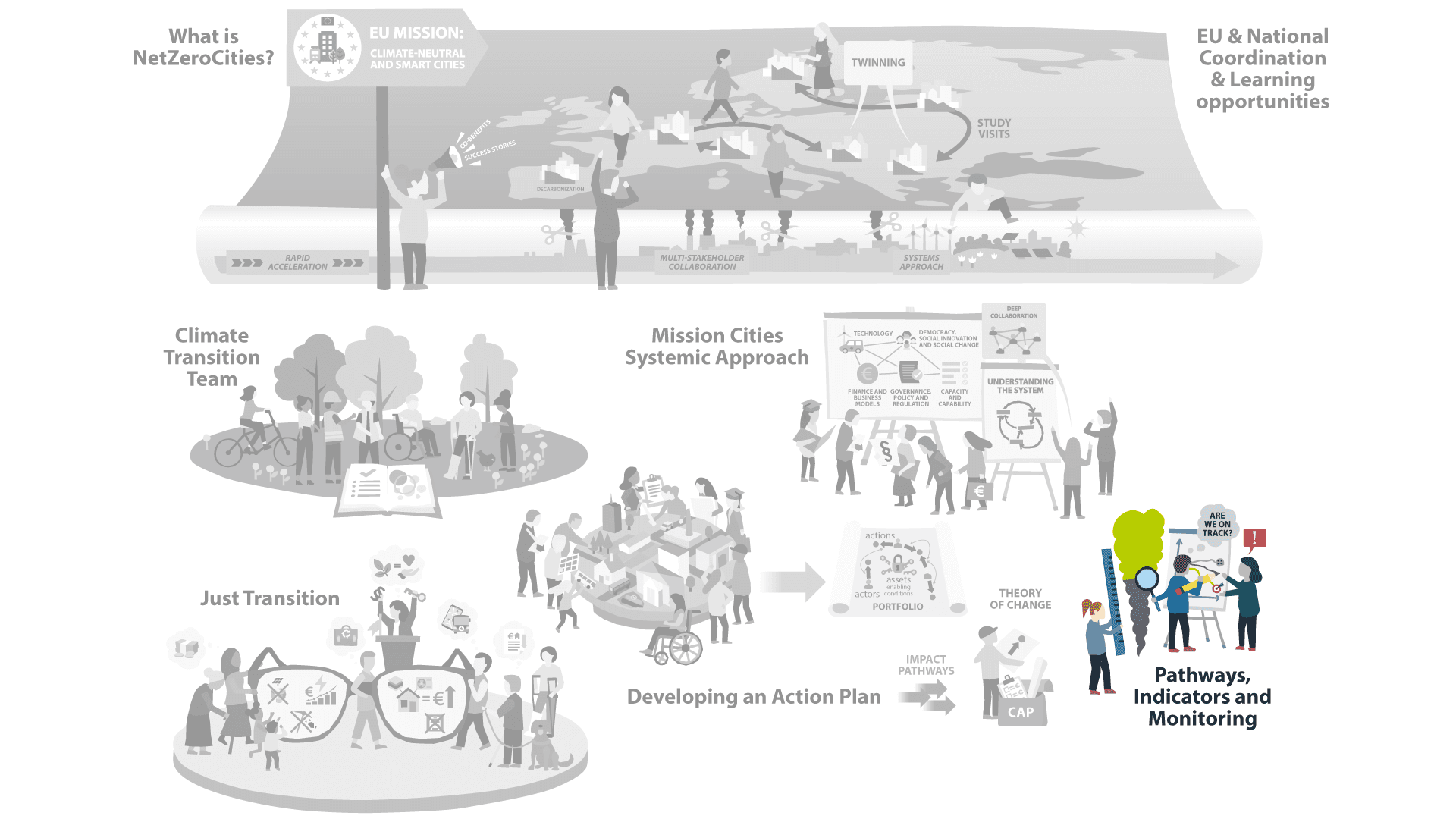
'Impact Pathways' tell a story about how systemic transformation is expected to unfold. 'Indicators' are a measurable data point used to track a city's progress towards achieving climate neutrality. These indicators evaluate the effectiveness of urban sustainability initiatives, such as reductions in carbon emissions or increases in renewable energy usage.
location_pin
Pathways, Indicators & Monitoring

In this page you will find why monitoring and learning are essential for tracking progress along cities’ climate transition plans and how they enable evidence-based and timely course-corrections. It outlines the defining features of the NZC Programme’s Monitoring, Learning and Impact framework and directs readers to relevant resources.

MONITORING & LEARNING FOR IMPACT

Effective monitoring helps quantify the progress of the portfolio of actions implemented, strengthens transparency and legitimacy and assesses the effectiveness of solutions. System-wide transformation for decarbonisation requires multi-sector monitoring and rapid feedback loops, while also measuring co-benefits as part of an integrated approach. Comprehensively understanding the bigger picture requires both qualitative and quantitative data. By monitoring progress, cities can evaluate their actions, learn from experiences, and course-correct to accelerate their journey toward climate neutrality. Transparent data-sharing with interested and affected stakeholders also helps cities mitigate the risk of greenwashing.

MONITORING & LEARNING IN NETZEROCITIES

Many cities have developed extensive in-house expertise in monitoring and learning over the years. The NetZeroCities programme helps these cities build upon and expand their existing capabilities while also providing support to those with limited capacities in this field. This dual approach ensures that all participating cities can effectively track their progress toward climate neutrality.

The NetZeroCities Theory of Change provides a systemic causal framework that outlines the process and interconnected components towards climate neutrality. This Theory of Change aligns with the programmatic goal of using systemic innovation and a portfolio approach through which cities can activate multiple levers of transformative change under a single emission domain. The six levers—technological innovation and infrastructure, finance and funding, social innovation, democracy and participation, governance innovation, and learning, capacity, and capability building—integrate the emission domains into a coherent portfolio. These levers serve as entry points for broader systems-wide transformations, aiding in the design and implementation of city actions. This approach not only creates pathways to achieve 2030 net-zero targets but also strengthens the MEL process, as it identifies and allows for the assessment of direct impacts and a variety of co-benefits along the way.

Videos
Reading Resources
CCC Highlights - Co-benefits and Indicators
This factsheet, part of a wider series titled “CCC Highlights”, explores the co-benefits labelled cities used to build their climate neutrality narrative beyond GHG emissions reductions and the indicators cities selected to evaluate the impact of their transitions.
QuickRead
Short overview of NetZeroCites MEL concepts
EC -Info-kit for cities
A practical guide from European Comission that offers resources and strategies towards climate neutrality at city level
Booklet - Integrating Mitigation and Adaptation
This booklet provides an introduction to adaptation and mitigation approaches and presents nature-based solutions as one of the key opportunities to integrate them.
Tools for climate action planning
In this page, you can find an overview of tools that cities can utilise for creating their action plan: NetZeroPlanner, Climateview, SuperUrbanity, Kausal and others
Online Planning Lab: Module 3 - Spotlight session on MEL
This session provides learning material for cities on how to establish a robust monitoring, evaluation and learning (MEL) process, to track systemic outcomes, GHG reductions and co-benefits achieved as a result of implementing CCC actions, and eventually refine their ambition and actions in future iterations of the action plan
Scientific publication "What Cities Want to Measure: Bottom-Up Selection of Indicators for Systemic Change toward Climate Neutrality Aligned with Sustainable Development Goals (SDGs) in 40 European Cities"
This study examines how cities are measuring the wider impacts of climate action beyond GHG emissions, using evidence from 40 European cities in the NetZeroCities project. It highlights cities’ preferences for non-GHG indicators linked to the Sustainable Development Goals (SDGs), showing how these can be used to assess progress, co-benefits and gaps in the transition to climate neutrality.
NetZeroCities Comprehensive Indicator Framework
The Indicator Framework provides a set of city-level indicators to monitor the impact of Climate City Contracts (CCCs), covering required indicators for direct GHG emissions impacts and recommended indicators for co-benefits and co-risks. It is designed for use with standard city data and is also available in spreadsheet format, with details such as definitions, units, sources, formulas and emission scope.
NetZeroCities Comprehensive Indicator Framework Spreadsheet
The Indicator Framework sets out a common set of indicators to monitor the impact of Climate City Contracts (CCCs), covering both required indicators for direct GHG emissions impacts and recommended indicators for co-benefits and co-risks. Cities are encouraged to select the indicators most relevant to their climate neutrality goals, based on the impact pathways and actions set out in their CCCs. These indicators are designed to be assessed at city level using standard data typically available across European cities.
NetZeroCities impact pathways diagram
NetZeroCities impact pathways diagram with active links to dedicated portal pages
Showcase
Learning from Cities

A map is loading