


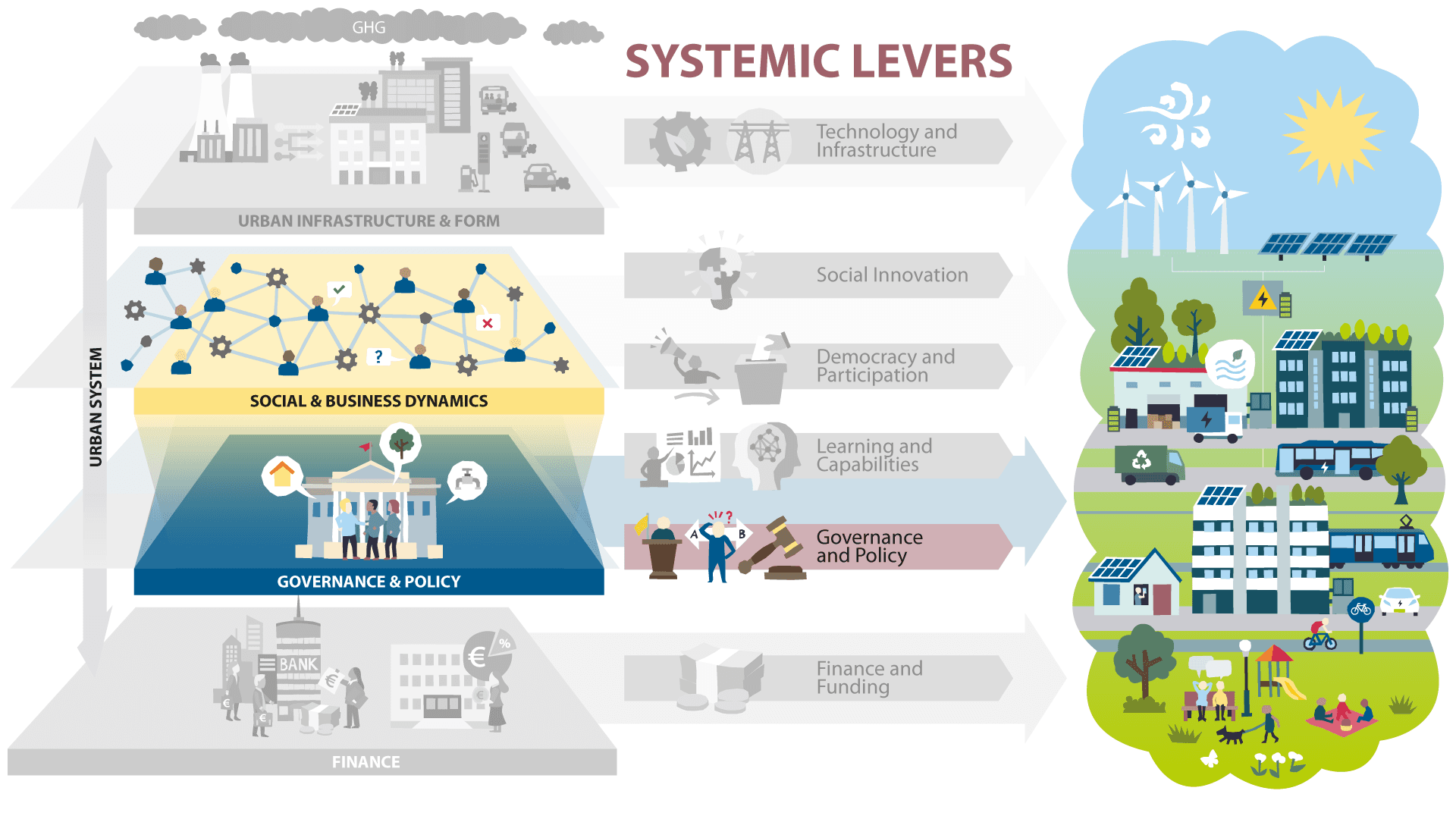

Governance innovations can enhance the capacity of actors to reach climate neutrality. Mission-driven collaboration is key to ensuring your city’s climate neutrality journey is supported by different actors and groups, and drawing upon resources and knowledge to tackle challenges that the city cannot solve alone. The better we govern collective action, the faster and fairer the required transformation is achieved. Governance can have narrower or broader definitions. More broadly, governance refers to both the “hard” (e.g. regulations, strategies, policies) and “soft” (skills, mindset, forms of collaboration) elements enabling or hindering societal transformation. Climate governance refers to the different ways that cities, other government levels and societal actors use to steer towards climate-neutrality, especially through holistic thinking and collaboration. Instead of one-off, sticking-plaster solutions, climate governance focuses on how the different strategies, actions, technical and social tools, etc., work together as a whole. Key elements of climate governance in cities
There are different ways to break down what this actually means. For example, from Demos Helsinki’s work, the definition above and next four interconnected modalities of climate governance help to look at the different levels and ways that change can be pursued in cities:
Domain-specific governance
‘Hard’ governance of systems, processes, and strategies in specific key domains (e.g. city planning, mobility, energy).
Cultural change
‘Soft’ governance of the culture, mindset, and capacities of the organisation and the people within it.
Capacity for ecosystem leadership
The ways in which cities interact with and incentivise the broader city ecosystem (e.g. private actors, citizens, civil society).
Multilevel governance
Governance of collaboration between cities in different forms and for different purposes as well as city-national and city-EU
You can use these modalities or ‘locations’ of governance to reflect what is your city’s intentional or unwritten governance approach to each, who should be involved, where the strengths and gaps lie, and which are most vital for your city’s transition.
A map is loading
